
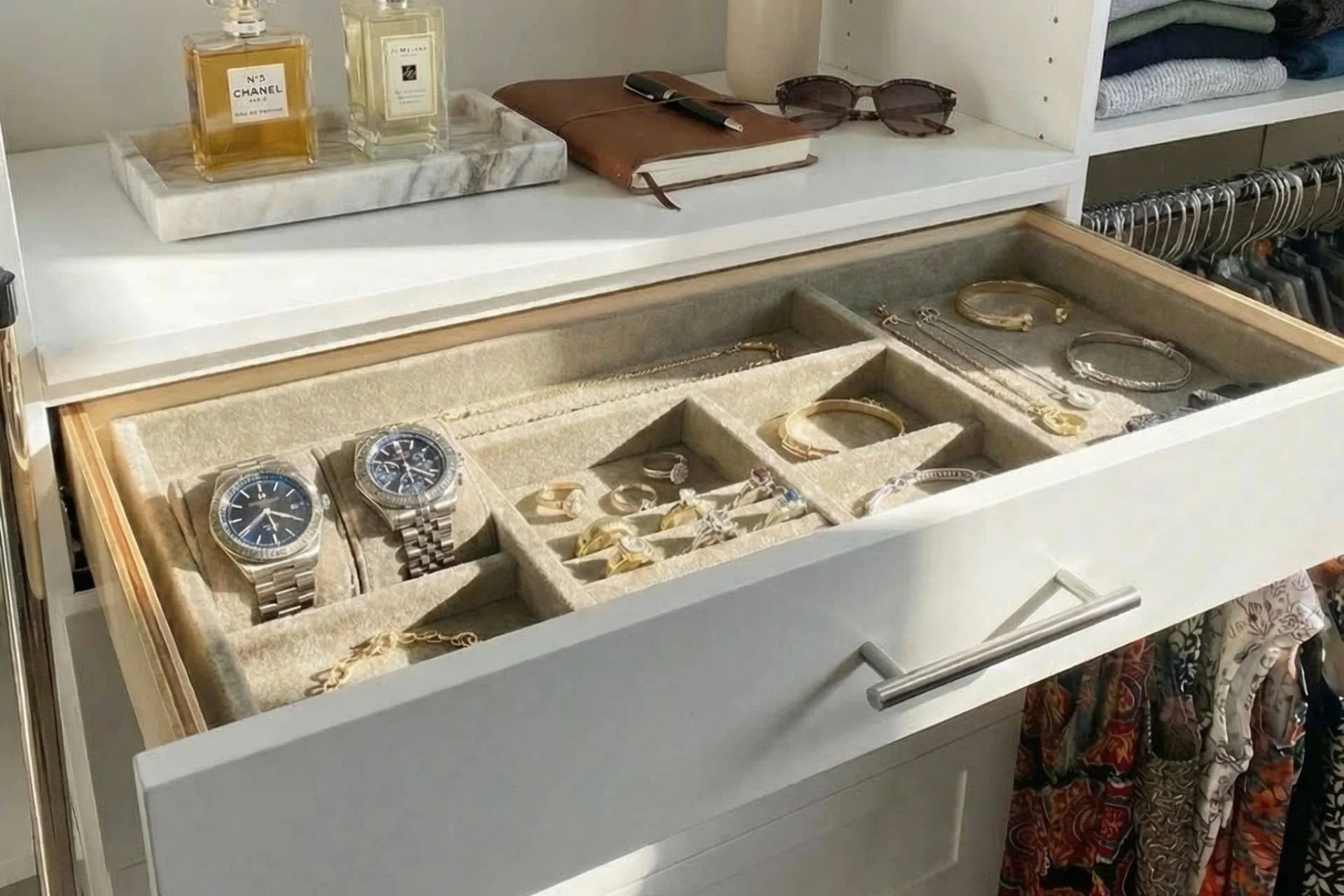
If you have ever started your morning by untangling a necklace, hunting for a missing earring, or realizing the bracelet you want is buried under three others in a dish on the dresser, you already know that jewelry storage is a real problem in most homes. It is not a habit problem. It is a design problem. And like most design problems, it has a solution.
The best way to store jewelry and accessories in a custom closet is to give each category its own dedicated home using a combination of velvet-lined jewelry drawers, pull-out trays, hooks and bars for longer pieces, and enclosed storage for valuables. The goal is a system where every piece is visible, accessible, and protected without requiring you to sort through everything else to find the one thing you want.
Why Do Standard Closets Fail at Jewelry Storage?
Most closets treat custom jewelry storage as an afterthought. A standard closet configuration has nowhere logical for a ring dish, a necklace stand, or a watch box, so everything ends up on the dresser, the bathroom counter, or stuffed into a drawer with no dividers. That arrangement works until it doesn't, which is usually around the third morning in a row spent hunting for a matching earring.
The problem compounds over time. Necklaces tangle. Earrings separate from their pairs. Rings get stacked in ways that scratch the stones. Watches sit in a pile rather than being stored flat. None of this happens because the homeowner is disorganized. It happens because the storage system was never designed to handle what jewelry really requires.
According to the 2025 Jewelers Mutual Travel Study, lockboxes and safes are the most common home storage methods people use for fine jewelry, which reflects how many homeowners are simply defaulting to security over organization because no better system exists in their closet. A well-designed custom closet solves both problems at once.
What Are the Best Jewelry Drawer Configurations?
A dedicated jewelry drawer is the single most impactful addition to a custom closet for anyone with a meaningful jewelry collection. Unlike a standard drawer with a tray dropped into it, a purpose-built jewelry drawer is designed from the start around the categories of jewelry being stored.
Shallow drawers lined in velvet or suede are ideal for rings, earrings, and bracelets. The lining protects pieces from scratching against each other and gives small items enough grip to stay in place. Individual compartments sized for each type of piece mean nothing shifts around or tangles during daily use. A ring roll section keeps rings upright and visible. Small square compartments handle stud earrings and small pendants. Longer rectangular compartments hold bracelets laid flat.
Deeper drawers work better for necklaces, which need more space to lay without tangling. A necklace drawer with individual hooks or pegs along the back panel keeps chains separated and visible at a glance. Being able to see the full necklace rather than just the clasp makes choosing one in the morning dramatically faster.
Watch storage deserves its own section in any jewelry drawer configuration. Watches stored flat in individual cushioned slots stay protected and are easy to grab without disturbing the rest. For larger watch collections, a dedicated watch drawer with cushioned rolls keeps every piece accessible and in good condition.
What Storage Solutions Work Best for Accessories?
Jewelry is only part of the accessory storage challenge in a custom closet. Belts, scarves, sunglasses, handbags, and hair accessories all need dedicated homes that keep them visible and easy to grab without disrupting the rest of the closet.
Pull-out belt and tie racks mount inside a cabinet or on the side of a shelving unit and keep belts and ties hung individually rather than coiled in a pile. Each piece hangs visible and wrinkle-free, which makes the morning routine faster and extends the life of the accessories themselves.
Scarf storage works best on pull-out bars or in shallow open cubbies where scarves can be folded and stacked by color or weight. Stuffing them into a drawer or hanging them over a single hook leads to the same tangle problem that plagues necklaces without a proper system.
Sunglasses deserve a dedicated shelf or shallow pull-out tray where each pair can sit flat without being stacked. For homeowners from Southport to Surf City who reach for sunglasses every day of the year, having them front and center in the closet rather than buried in a bag or a drawer is one of those small changes that makes a noticeable daily difference.
Handbags are one of the most common closet storage challenges and one of the easiest to solve with the right design. Open shelves at varied heights, pull-out shelves that bring bags forward, and dedicated hooks for clutches and smaller bags keep every handbag visible and accessible without being stacked on top of each other.
How Does Lighting Improve Jewelry and Accessory Storage?
A jewelry drawer or accessory section that is hard to see does not get used properly. According to Future Market Insights, about 33 percent of consumers invest in jewelry organizers specifically to avoid tangling, misplacement, or damage, which reflects how much daily friction poor jewelry storage creates. Lighting is a key part of solving that problem, and in a custom closet it is a functional necessity rather than a luxury addition.
Under-shelf lighting above a jewelry drawer or motion-activated lighting inside a cabinet makes it easy to see stones, metals, and fine details clearly without straining in a dim space. Motion-activated lighting is particularly useful because it turns on the moment you open a drawer or cabinet door without requiring a separate switch. In coastal NC homes where natural light varies significantly by room orientation and time of year, built-in closet lighting ensures the jewelry section works as well at six in the morning as it does at noon.
How Do You Organize Jewelry by Frequency of Use?
The same principle that governs the rest of a well-designed custom closet applies to jewelry storage: the things you reach for most often should be the easiest to access, and the things you use occasionally can live in less prime real estate.
Everyday pieces, including the rings you never take off, the earrings you wear most mornings, and the watch you reach for daily, belong at eye level and in the most accessible drawer or tray in the jewelry section. Pieces worn occasionally for special events, heirlooms, and fine jewelry worn only a few times a year can live in deeper storage, a higher shelf, or an enclosed cabinet with a lock for added security.
This organization-by-frequency approach keeps the morning routine fast and reduces the wear on pieces that should only come out for the right occasion.
Ready to Design a Custom Closet With the Right Jewelry Storage?
At Carolina Custom Closets, our experienced design team has spent over 20 years helping homeowners from Wilmington to Wrightsville Beach, Leland to Holly Ridge, design closets that work for how they live. Jewelry and accessory storage is one of the most personal parts of any closet design, and we approach it the same way we approach everything else: by listening first and building outward from there.
Every project is fully custom, manufactured right here in North Carolina, and backed by a lifetime warranty and our best price promise. Our highly rated in-house team handles every project from design through installation with no outside contractors.
Contact us today to schedule your free in-home design consultation.
Frequently Asked Questions
-
The most effective approach is a combination of velvet-lined shallow drawers for rings, earrings, and bracelets, a deeper drawer with individual hooks or pegs for necklaces, cushioned watch slots for timepieces, and pull-out trays for everyday pieces. Organizing by frequency of use keeps the most-worn pieces most accessible.
-
A dedicated necklace drawer with individual hooks or pegs along the back panel keeps each chain separated and visible. Pull-out necklace bars that mount inside a cabinet door are another option. Both solutions keep necklaces hanging individually so they do not shift or tangle during daily use.
-
Belts, scarves, sunglasses, handbags, and watches all benefit from dedicated storage solutions. Pull-out racks for belts and ties, shallow trays for sunglasses, open shelves at varied heights for handbags, and cushioned watch drawers each address the specific storage needs of those categories without requiring them to share space with other accessories.
-
Yes. Lighting inside a jewelry drawer or accessory section makes it significantly easier to find specific pieces quickly, see stone and metal details clearly, and avoid grabbing the wrong item in low light. Motion-activated LED lighting inside drawers and cabinets is one of the most practical upgrades in a custom closet jewelry section.
-
For most homeowners with a meaningful jewelry collection, yes. A purpose-built jewelry drawer eliminates the daily frustration of tangled pieces and missing items, protects jewelry from scratching and damage, and keeps everything visible and accessible without requiring a separate storage solution on the dresser or bathroom counter.